9 Creepy Details That Make Arizona’s Two Guns Ghost Town Feel Like a Real-Life Thriller Set
TWO GUNS, AZ — Along old Route 66 in northern Arizona, Two Guns is the kind of place that seems to hold its breath. What started as a roadside curiosity became a decaying landmark shaped by violence, tall tales, and the slow takeover of the desert. These nine details help explain why the ghost town still feels so unnerving today.
1. The site sits beside one of Arizona’s most dramatic canyons
Two Guns is tucked near Canyon Diablo, where the landscape itself adds to the unease. The canyon slices through the desert like a deep scar and once created a difficult crossing for travelers and settlers. That isolation helped make the area feel wild long before it became a tourist stop. Even now, the drop-off and open sky give the ruins a cinematic, slightly threatening backdrop.
2. Its dark reputation began with the Death Cave story
Long before the roadside attraction existed, the land was tied to a grim tale from the late 1800s. The story says Apache warriors attacked a Navajo group, and the survivors trapped the raiders in a cave where they suffocated. The cave became known as the Death Cave, and that name stuck. Whether every detail is settled history or partly legend, the place was already associated with death before tourism ever arrived.
3. Harry Miller turned the ruins into a macabre business
In the 1920s, Harry Miller, who called himself Two Gun Miller, built a roadside attraction around the site. He charged visitors to look at the cave and hear gruesome stories about the land. Miller also claimed Native American heritage and presented himself as an authority on the canyon’s past. His operation mixed marketing, myth, and spectacle in a way that made the place famous and infamous at the same time.
4. Miller’s attraction included bones and a zoo
Two Guns was never a normal roadside stop. Visitors could pay to see what Miller said were bones in the cave, and the property also featured a zoo-like display. Mountain lions, bobcats, and other animals were kept in stone cages carved into the canyon walls. For travelers on Route 66, it was a bizarre mix of frontier showmanship and unsettling theater, and it helped the attraction draw thousands of visitors a year at its peak.
5. A 1926 killing deepened the town’s violent image
The town’s reputation darkened further in 1926, when Miller shot and killed Harry Brooks during a dispute over land ownership. Miller said it was self-defense and was not convicted, but the shooting left a lasting stain on Two Guns. The business never truly recovered after that episode. What had once been a strange but profitable stop along the highway began to feel less like entertainment and more like a place marked by real danger.
6. Route 66 made Two Guns famous before the bypass
Two Guns thrived during the heyday of Route 66, when motorists were eager for memorable places to stop. Miller’s signs lured drivers in with promises of wild animals, canyon views, and frontier oddities. The site had a trading post, a gas station, and enough bizarre charm to become one of those places people remembered long after the trip ended. When Interstate 40 later bypassed the old corridor in the 1970s and 1980s, the traffic dried up and the attraction faded fast.
7. The ruins still show how large the operation once was
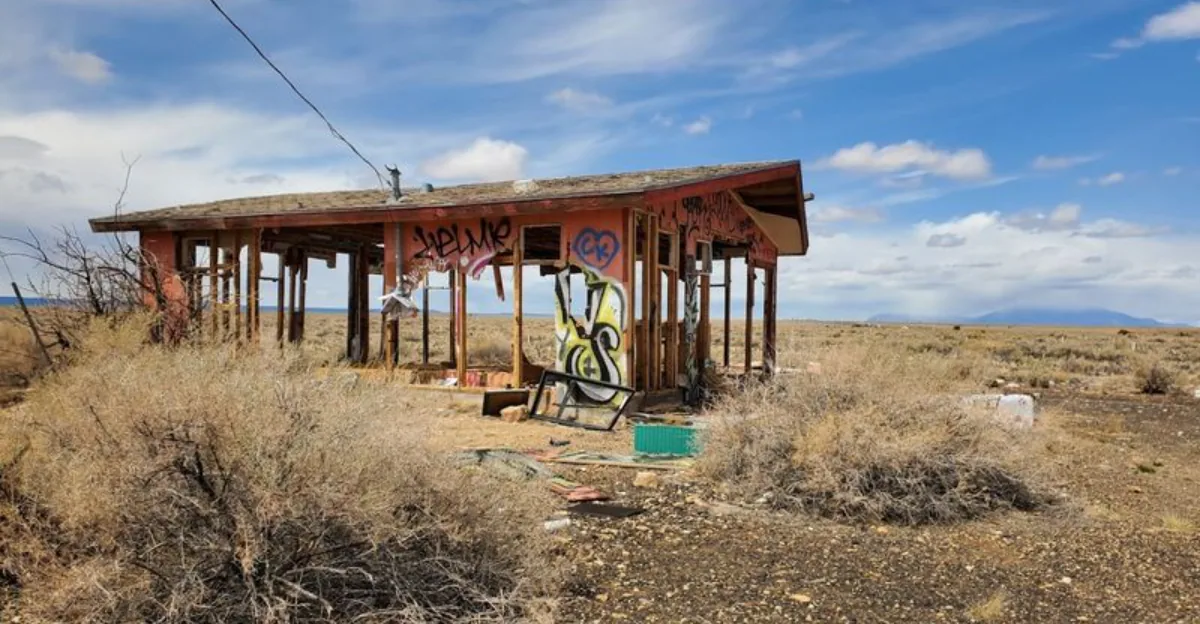
Today, stone walls and broken structures remain scattered across the site, and they make the ghost town feel stubbornly present. The old trading post, the cages, and pieces of other buildings still stand against the desert sky. Some areas have been tagged with graffiti, but even that does little to soften the mood. Instead, the ruins make it easier to imagine how busy and strange the place must have looked when road trips kept it alive.
8. Fires and floods helped finish the job
Violence was only part of Two Guns’ downfall. Fires destroyed wooden structures more than once, and flash floods tore through the canyon and weakened what was left. After Miller’s era, the property changed hands several times, and later attempts to revive it never lasted. The desert kept reclaiming the site piece by piece, so by the time the highway changed, there was very little left to save.
9. Visitors still come for the eerie silence
Modern explorers often describe Two Guns as surreal the moment they step out of the car. There is no visitor center, no polished exhibit, and no real buffer between the road and the ruins. What they find instead is silence, uneven ground, and a sense that the place is still holding onto its history. With the canyon nearby and the wind moving through broken walls, Two Guns feels less like a leftover attraction and more like a scene that never fully ended.
What makes Two Guns unforgettable
Two Guns stands out because its atmosphere comes from both the land and the layered history built on top of it. The canyon, the ruins, the roadside mythology, and the hard facts of violence all blend into one haunting destination. For travelers who like places with a strange past, it is a reminder that some of the most memorable landmarks are the ones time never fully erased.